
Mutual Funds vs Stocks 2026 – Smart & Powerful Investment Guide for Beginners
Mutual funds vs stocks 2026 is one of the biggest money decisions Indian investors are making this year.
With inflation eating into savings and markets moving up and down quickly, it’s normal to feel stuck:
should you start with mutual funds, or jump into direct stock investing?
Here’s the honest answer: both can build serious wealth, but they suit different people.
If you prefer simplicity and steady discipline, mutual funds win. If you enjoy learning businesses, tracking numbers,
and you can handle volatility, stocks can reward you more. This guide helps you pick the right option for your situation.
Why the Mutual Funds vs Stocks 2026 Debate Matters
Most beginners don’t lose money because the market is “bad” — they lose because they choose a strategy they can’t stick to.
Choosing between mutual funds and stocks decides:
- How much risk you take
- How much time you need to spend learning
- How emotional your investing journey becomes
- How consistent you’ll be during market falls
In 2026, consistency matters more than ever because volatility is normal. The best plan is the one you can continue for years.
What Are Mutual Funds?
A mutual fund pools money from many investors and invests it across a basket of assets (usually stocks and/or bonds).
The fund is run by a professional team that decides what to buy, what to sell, and how much to allocate.
Types of Mutual Funds in 2026
- Large-cap funds (more stable, established companies)
- Mid-cap funds (higher growth potential, higher volatility)
- Flexi-cap funds (can invest across large/mid/small caps)
- Index funds (tracks Nifty/Sensex; low cost)
- Hybrid funds (mix of equity + debt; balanced approach)
The biggest advantage: you can start with SIP (Systematic Investment Plan) from ₹500/month and build discipline without timing the market.
If you’re new to the market, read this first:
How to Start Investing in Stock Market
What Are Stocks?
Stocks (shares) mean direct ownership in a company. If the company grows and profits increase, the stock price can rise.
Some companies also pay dividends.
But with direct stocks, you are the fund manager. That means you must:
- Choose companies (based on business quality, valuation, growth)
- Monitor results (quarterly performance, major news, risks)
- Manage risk (diversification, position sizing)
- Control emotions during market crashes and hype cycles
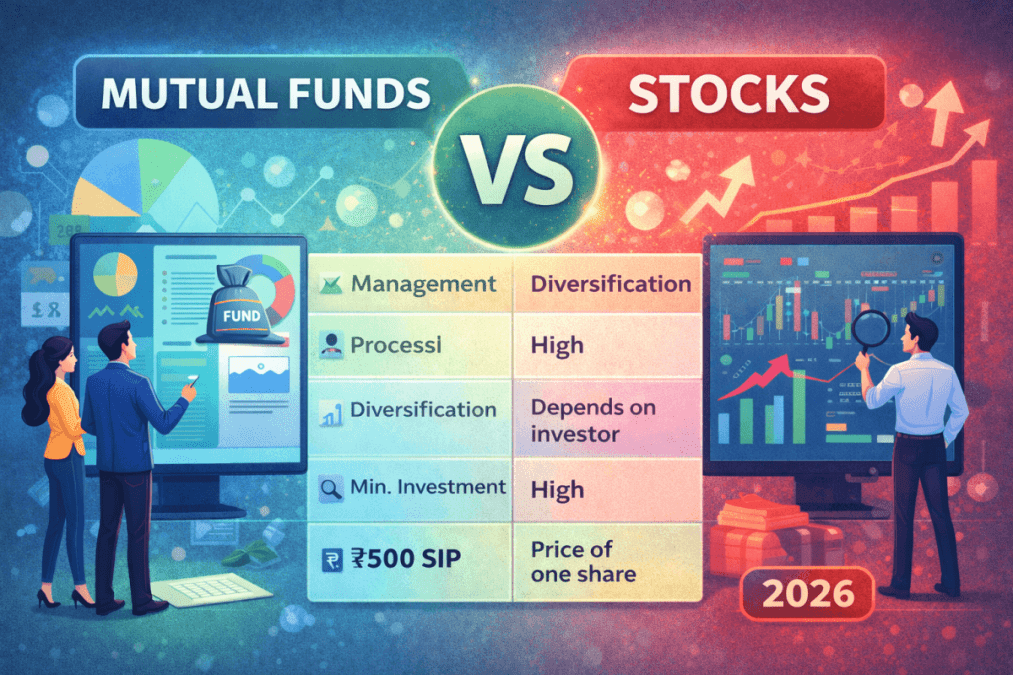
Mutual Funds vs Stocks 2026 – Detailed Comparison
| Factor | Mutual Funds | Stocks |
|---|---|---|
| Management | Professional fund manager | You manage everything |
| Diversification | High (built-in) | Depends on your choices |
| Risk | Moderate (varies by fund) | Higher (especially concentrated portfolios) |
| Time Required | Low | Medium to high |
| Minimum Investment | ₹500 SIP | Price of one share |
| Costs | Expense ratio | Brokerage + taxes + your mistakes (if unmanaged) |
Beginner Roadmap 2026 – How to Choose
Step 1: Check your risk tolerance
- Low risk: index funds / large-cap mutual funds
- Medium risk: diversified mutual funds + a few quality stocks
- High risk: stocks (only if you can research + stay calm)
Step 2: Check your time commitment
- No time: mutual funds (SIP) is best
- Can learn weekly: add a stock portfolio slowly
Step 3: Start with a simple allocation
Example 2026 starter portfolio:
- 60% Index Funds
- 20% Flexi-cap Fund
- 20% Direct Stocks (only high quality, not “tips”)
Best Brokers for 2026 (Stocks + Mutual Funds)
| Broker | Best For | Strength |
|---|---|---|
| Zerodha | Long-term investors | Low-cost, stable platform |
| Groww | Beginners | Simple UI + easy onboarding |
| Upstox | Active users | Fast execution + trading tools |
| Angel One | Research-focused users | Research + advisory features |
Tip: If your goal is long-term investing, choose a broker you can trust for years (not the one with the most ads).
Risk Reality Check in 2026
Stocks can fall 30–50% during market corrections. This is normal.
The problem is not the fall — the problem is panic selling.
Mutual funds reduce the impact because they spread risk across many companies.
For official investor education and warnings, check:
SEBI (Official)
and the exchange site:
NSE India (Official).
Returns Comparison (What to Expect)
Over long periods, diversified equity mutual funds have historically delivered around 10–14% annualised returns.
Stocks can deliver higher returns — but only if you choose well and hold through volatility.
In mutual funds vs stocks 2026, remember: the “best” return is the return you actually stick with.
Many beginners quit stocks during a crash and lock losses. SIP investors usually continue.
Taxation 2026 (Simple)
- STCG (short term): 15%
- LTCG (long term): 10% above ₹1 lakh (equity)
Equity mutual funds and stocks are taxed similarly. Your real difference is discipline, not tax.
Real Example – ₹10,000 per Month (Mutual Funds vs Stocks 2026)
Imagine you invest ₹10,000/month for 15 years.
A disciplined SIP in an index fund at around 12% average long-term return can grow to a large corpus due to compounding.
Stocks can outperform — but only if you don’t panic sell and you avoid poor-quality “hot picks”.
That’s why many smart investors build a stable core using mutual funds, and then add stocks slowly as they learn.
Smart Hybrid Strategy (Recommended)
The most practical strategy in 2026 is often a hybrid approach:
- 70% Mutual Funds / Index Funds (core stability)
- 30% Direct Stocks (growth potential)
This balances stability + growth and reduces emotional stress.
Common Mistakes to Avoid
- Chasing quick profits or “guaranteed returns”
- Buying stocks only because a friend or influencer recommended them
- Overtrading (too many buys/sells)
- Panic selling during a market fall
- Ignoring costs (expense ratios, taxes, brokerage)
Related Guides on Credit Guide India (Internal Links)
- How to Start Investing in Stock Market
- Credit Card Fees & Charges in India 2026
- Personal Loan Interest Rates India 2026
- Best Fuel Credit Cards India 2026
Final Verdict – Mutual Funds vs Stocks 2026
The best answer to mutual funds vs stocks 2026 depends on your personality.
If you want simplicity, start with mutual funds and SIP.
If you enjoy learning businesses and you can handle volatility, add stocks gradually.
The real “secret” isn’t choosing one option — it’s staying consistent for years.
That’s how long-term wealth gets built.